
Condensation on Windows in Winter: Could Your Air Exchanger Be the Problem?
By the Pur Air Solution team · October 7, 2026
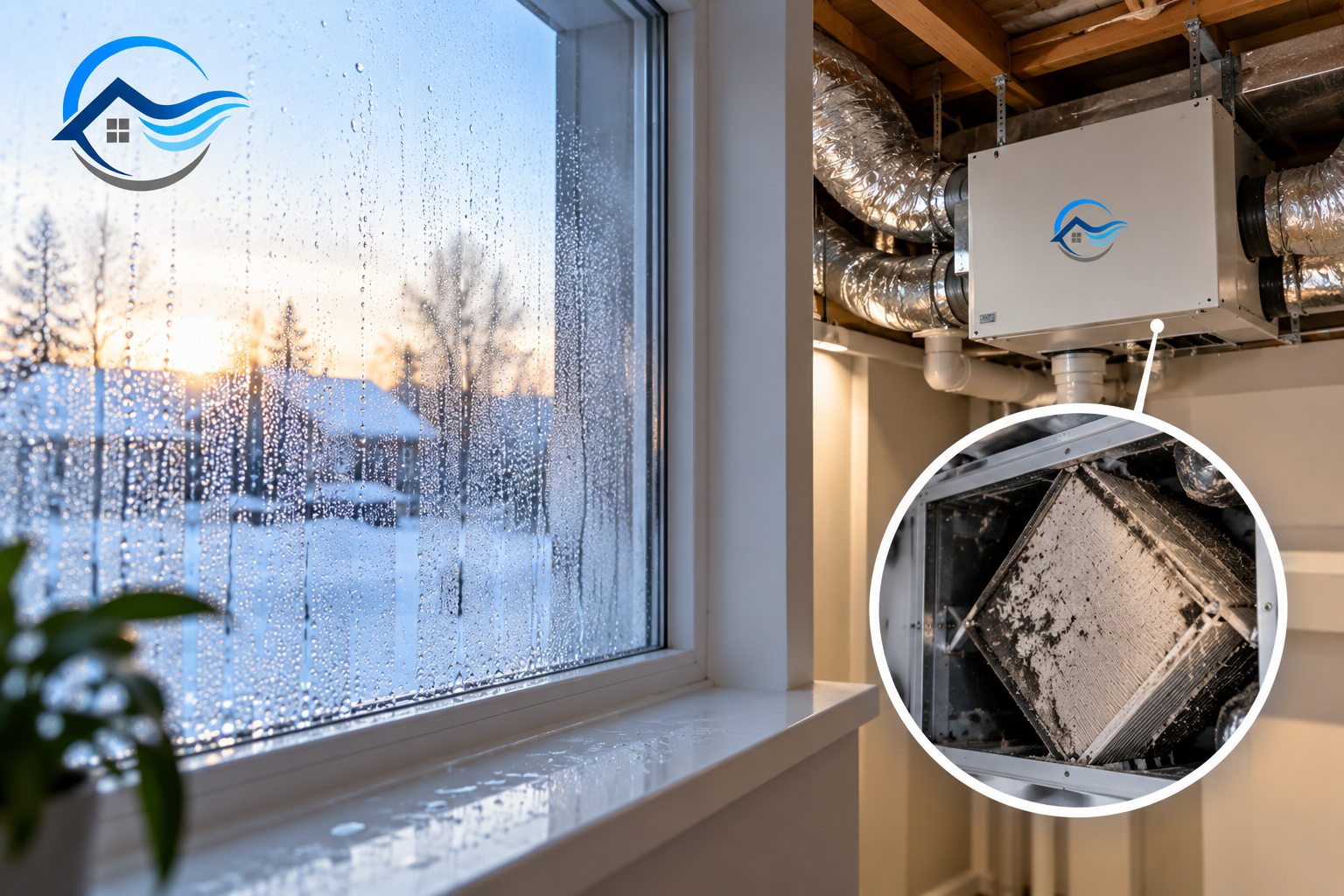
Discover why windows develop condensation in winter, how your air exchanger affects indoor humidity, and the signs your ventilation system may need cleaning.
Need a professional cleaning?
Our experts are available 7 days a week in Montreal, Laval and the South Shore.
Introduction
You wake up on a cold Montreal morning and notice water droplets covering the inside of your windows.
Sometimes it is only a thin layer of condensation near the bottom of the glass. In other cases, the windows are completely fogged, water collects on the sill, or moisture appears repeatedly whenever temperatures drop outside.
For many homeowners, the first question is simple:
Why is there so much condensation on my windows in winter?
Window condensation is often connected to a combination of indoor humidity, outdoor temperature, surface temperature, ventilation, and the performance of the windows themselves.
Your air exchanger can be part of that equation.
During Quebec winters, homes remain closed for long periods while everyday activities such as cooking, showering, cleaning, and simply occupying the home continuously add moisture to indoor air.
A properly operating ventilation system helps replace stale indoor air with outdoor air and can contribute to controlling excess indoor humidity during the heating season.
But if an air exchanger is dirty, poorly maintained, incorrectly operated, or experiencing an airflow problem, ventilation may not perform as intended.
That does not mean every foggy window proves that your air exchanger is dirty.
However, persistent condensation can be a useful signal that it is time to look at the home's overall ventilation and humidity conditions.
For homeowners throughout Montreal, Laval, Longueuil, Brossard, Terrebonne, Blainville, Repentigny, Vaudreuil-Dorion, the South Shore, and the North Shore, Pur Air Solutions provides professional air exchanger cleaning and other ventilation cleaning services.
Let's look at why condensation occurs, how your air exchanger fits into the picture, and which signs may indicate that the system needs attention.
What Causes Condensation on Windows?
Condensation occurs when humid indoor air comes into contact with a surface cold enough for some of the water vapour in that air to turn into liquid water.
During winter, windows are often among the coldest surfaces in a home.
The colder it becomes outside, the colder the interior surface of the glass can become.
If indoor humidity is high enough, moisture can begin appearing on the glass.
This explains why condensation may be minimal on a relatively mild winter day but much more noticeable during a very cold period.
Three factors are especially important:
- The amount of moisture in the indoor air
- The temperature of the window surface
- The amount of ventilation in the home
The condition and thermal performance of the windows also matter.
This is why diagnosing winter condensation requires looking at the house as a complete system rather than blaming one piece of equipment immediately.
Where Does Indoor Humidity Come From?
Moisture is constantly being produced inside a home.
Normal everyday activities add water vapour to indoor air.
Common sources include:
- Cooking
- Showering and bathing
- Drying clothes indoors
- Cleaning
- Houseplants
- Occupants
- Humidifiers
- Other household activities involving water
A family living in a home can therefore generate moisture every day without having any plumbing leak or obvious water problem.
In summer, this moisture behaves differently because windows and other surfaces are generally warmer.
During a Montreal winter, however, cold exterior temperatures create much colder surfaces where condensation can form.
Ventilation becomes particularly important because it helps remove humid indoor air and introduce outdoor air.
What Does an Air Exchanger Actually Do?
An air exchanger is designed to provide controlled ventilation.
Instead of relying entirely on opening windows, the system mechanically removes stale indoor air and introduces outdoor air.
Many Quebec homes use a heat recovery ventilator (HRV), while some installations use an energy recovery ventilator (ERV).
The exact operation depends on the equipment.
In an HRV, heat from outgoing indoor air is transferred through a heat-exchange core to help temper the incoming outdoor air without directly mixing the two air streams.
This allows the home to receive fresh outdoor air while recovering part of the heat that would otherwise be lost.
An air exchanger can therefore play an important role in:
- Replacing stale indoor air
- Removing excess indoor moisture during appropriate conditions
- Supporting overall home ventilation
- Exhausting certain indoor pollutants
- Bringing outdoor air into the home in a controlled manner
But for the system to perform properly, air must be able to move through it.
That is where maintenance becomes important.
1. Persistent Window Condensation May Indicate Insufficient Ventilation
A little condensation during extremely cold weather does not automatically indicate a ventilation problem.
Conditions can vary significantly depending on outdoor temperature, indoor humidity, window performance, curtains, blinds, and other factors.
However, if windows remain heavily covered with condensation for long periods, especially throughout multiple rooms, the home's humidity and ventilation should be evaluated.
Health Canada identifies persistent condensation on windows as one possible sign of excess indoor moisture or insufficient ventilation.
An air exchanger is one component worth checking in a home equipped with mechanical ventilation.
Questions to consider include:
- Is the air exchanger actually running?
- Are the filters clean?
- Are the exterior intake and exhaust openings clear?
- Is airflow noticeably weaker than before?
- Has the system been maintained recently?
- Are bathroom and kitchen exhaust systems operating correctly?
The objective is to understand why moisture is accumulating rather than automatically assuming that the windows or air exchanger are defective.
2. Dirty Filters Can Restrict Airflow
Filters are one of the most basic maintenance points in an air exchanger.
They capture particles before air reaches other parts of the equipment.
As dust accumulates, airflow through the filters can become more restricted.
Reduced airflow can interfere with the ventilation system's ability to exchange air effectively.
This is why filters should be inspected and maintained according to the manufacturer's instructions.
Depending on the model, they may be washable, reusable, or replaceable.
Homeowners should avoid assuming that every air exchanger uses the same filter or maintenance procedure.
Always consult the instructions for your specific equipment.
If filters have been neglected for a long period, checking them is a logical first step when investigating poor ventilation.
3. The Heat-Recovery Core Can Accumulate Dust
The filters are not the only part of an air exchanger that requires attention.
An HRV contains a heat-recovery core through which the incoming and outgoing air streams pass.
Although filters help protect this component, dust can still accumulate over time.
Depending on the model, the core may require periodic inspection and cleaning according to the manufacturer's instructions.
A dirty core can interfere with airflow and heat-transfer performance.
It is important, however, to clean the core correctly.
Different types of equipment can have different maintenance requirements, and not every component should be cleaned in the same way.
Following the manufacturer's instructions is essential.
4. Exterior Air Intake and Exhaust Hoods Can Become Obstructed
Some of the most important parts of an air exchanger are located outside the house.
One opening brings outdoor air into the system.
Another allows stale indoor air to be exhausted.
These exterior hoods can become partially obstructed by:
- Snow
- Ice
- Leaves
- Dirt
- Debris
This is particularly relevant during Quebec winters.
A heavy snowfall or drifting snow can interfere with an exterior opening even if the air exchanger itself is perfectly clean inside.
Homeowners should periodically look at exterior intake and exhaust openings and make sure they remain clear.
Never assume that reduced ventilation is automatically caused by dirty ducts when the problem may simply be an obstructed exterior hood.
5. A Dirty Air Exchanger May Produce Weaker Airflow
Have you noticed that airflow from the ventilation grilles seems weaker than it used to?
Several causes are possible.
They can include:
- Dirty filters
- Dirty internal components
- Obstructed exterior openings
- Duct restrictions
- Incorrect system settings
- Mechanical problems
- Fan problems
Weak airflow is therefore a symptom rather than a diagnosis.
However, if airflow has gradually declined and the air exchanger has not been maintained for a long time, inspection and cleaning may be appropriate.
Professional air exchanger cleaning from Pur Air Solutions can address accumulated dust and debris in relevant components and connected ventilation areas.
6. Bathroom Humidity Takes Longer to Disappear
A hot shower can quickly raise humidity in a bathroom.
The bathroom exhaust fan is normally the primary system used to remove moisture directly from that room.
But the home's overall ventilation also influences how quickly indoor humidity returns to normal.
If mirrors and surfaces remain wet for unusually long periods, or moisture seems to persist throughout the home after showers, it may be worth checking both the bathroom exhaust system and the home's ventilation.
Pur Air Solutions also provides bathroom fan cleaning for exhaust systems that have accumulated dust and debris.
A dirty bathroom fan and a poorly maintained air exchanger can exist at the same time.
Looking at both systems can provide a more complete picture.
7. Cooking Can Add Significant Moisture to Indoor Air
Cooking also releases moisture.
Boiling water, simmering food, using multiple burners, and other cooking activities can increase indoor humidity.
A properly functioning kitchen exhaust system can help remove moisture and cooking pollutants at the source.
If moisture remains trapped inside the home, winter window condensation can become more noticeable.
This is another reason why the air exchanger should not be evaluated in isolation.
Kitchen ventilation, bathroom exhaust, air leakage, indoor humidity, and mechanical ventilation all interact.
Pur Air Solutions provides kitchen hood cleaning for systems requiring maintenance.
8. Too Much Indoor Humidity Can Increase Condensation
A home can sometimes simply contain more moisture than the cold exterior conditions allow without condensation appearing.
This is particularly important during periods of very cold weather.
An indoor humidity level that causes no visible problem when temperatures are mild may produce significant condensation when outdoor temperatures fall sharply.
This does not necessarily mean something suddenly broke.
The relationship between indoor humidity and exterior temperature has changed.
Homeowners using humidifiers should pay particular attention to this.
If windows are consistently wet, increasing humidity further is unlikely to help.
The home's actual humidity level should be measured and ventilation conditions evaluated.
A simple hygrometer can help homeowners monitor relative humidity rather than guessing based only on comfort.
9. Very Dry Air Can Also Be a Problem
The opposite extreme is not desirable either.
Some homeowners see condensation and immediately try to make the house as dry as possible.
That is not the objective.
Indoor humidity affects comfort, and excessively dry air can also be uncomfortable.
The goal is not to eliminate humidity completely.
Instead, the goal is to maintain an appropriate balance based on indoor conditions, outdoor temperature, building characteristics, and ventilation.
Because conditions change throughout winter, the ideal strategy may also change.
10. Your Windows May Be Part of the Problem
Not all window condensation is caused by ventilation.
Window characteristics can have a major influence.
Older or less efficient windows may have colder interior surfaces than newer high-performance windows.
Other factors can also influence surface temperature, including:
- Window construction
- Air leakage
- Insulation around the frame
- Curtains
- Blinds
- Furniture blocking warm air circulation
If condensation occurs on only one window while every other window remains dry, the issue may be more localized.
If almost every window in the home is heavily wet, overall indoor humidity and ventilation deserve more attention.
The pattern can provide useful clues.
Condensation Between the Glass Panes Is Different
There is an important distinction between condensation on the indoor surface of a window and moisture between the panes of insulated glass.
If moisture appears trapped between panes where you cannot wipe it away from either side, the problem may involve the window's sealed glazing unit.
An air exchanger cannot correct a failed window seal.
This is a good example of why diagnosing the location of the moisture matters before assuming the ventilation system is responsible.
Is Your Air Exchanger Actually Running?
This sounds obvious, but it is worth checking.
Some homeowners have an air exchanger but rarely adjust or inspect its controls.
The unit may be:
- Turned off
- Operating at an inappropriate setting
- Controlled by a wall control
- Operating intermittently
- In a different mode than expected
Before assuming the equipment needs deep cleaning, confirm that it is operating according to the manufacturer's instructions.
If you are unsure how the controls work, consult the owner's manual or an appropriate HVAC professional.
Should You Run an Air Exchanger During Winter?
Mechanical ventilation is particularly useful when homes remain closed for long periods.
The correct settings, however, depend on the equipment and the home.
Some systems offer different speeds or operating modes.
Many also incorporate defrost strategies for cold weather.
Instead of applying one universal setting to every home, follow the manufacturer's instructions and consider the building's actual humidity and ventilation needs.
Turning the system off for the entire winter simply because outdoor air is cold may defeat the purpose of having mechanical ventilation.
Frost and Ice Do Not Automatically Mean the Unit Is Dirty
Montreal winters can be extremely cold.
HRVs are designed to operate in cold climates, and many incorporate defrost cycles or other frost-control strategies.
Frost behaviour depends on the equipment and outdoor conditions.
If the system repeatedly freezes, stops operating correctly, or develops unusual amounts of ice, the cause should be evaluated.
The issue may involve:
- Exterior obstruction
- Drainage
- Defrost operation
- Installation
- Airflow
- Mechanical problems
Cleaning may help when dirt is contributing to airflow problems, but frost is not automatically proof that the air exchanger is dirty.
Don't Forget the Condensate Drain
Some air exchangers produce condensation that must drain properly.
Depending on the model and installation, the system may include a drain pan, tubing, or other drainage components.
If drainage becomes restricted, water can accumulate where it should not.
Homeowners should follow the manufacturer's maintenance instructions for the drain and related components.
If there is water leaking around the unit, persistent pooling, or an unexplained moisture problem, the cause should be investigated.
What Can Homeowners Clean Themselves?
Basic homeowner maintenance may include several tasks, depending on the model:
- Inspecting filters
- Cleaning or replacing filters as specified
- Checking exterior intake and exhaust hoods
- Keeping snow and debris away from exterior openings
- Checking accessible grilles
- Looking for unusual water accumulation
Some manufacturers also provide homeowner instructions for cleaning the heat-recovery core.
Always follow the specific manual.
Air exchangers are not all built the same way, and components that can be washed on one model may require different treatment on another.
When Is Professional Air Exchanger Cleaning Useful?
Professional service becomes especially relevant when the system has accumulated significant debris, accessible homeowner maintenance does not resolve airflow problems, or the internal and connected components have not been inspected for a long period.
It may also be useful when:
- Airflow remains weak after filter maintenance
- Internal buildup is visible
- Persistent odors appear
- Renovation dust may have entered the system
- The condition of connected ducts is unknown
- The homeowner cannot safely access the components requiring attention
The objective should be to clean the areas that actually require service—not to replace basic homeowner maintenance unnecessarily.
What About the Air Exchanger Ducts?
An air exchanger is connected to ductwork that carries outdoor air and exhaust air through the building.
Depending on the installation, it may also connect to distribution and extraction grilles throughout the home.
Over time, the condition of these ducts may need to be evaluated.
However, just like central HVAC ducts, they should not automatically be assumed to require cleaning on a fixed schedule.
Their condition, system design, filtration, previous renovations, and actual accumulation all matter.
When the inside cannot be evaluated easily, professional inspection can help.
Pur Air Solutions also offers camera duct inspection for situations where hidden conditions need to be examined.
Air Exchanger Cleaning After Renovations
Renovations deserve special attention.
Drywall sanding, wood cutting, demolition, flooring work, and other construction activities can produce significant amounts of airborne dust.
If the ventilation system was operating during dusty work without adequate protection, some particles may reach filters, grilles, ducts, or internal components.
After major renovations, homeowners should inspect their filters and accessible ventilation equipment.
If significant construction dust entered the system, professional inspection or cleaning may be appropriate.
This complements the same post-renovation approach used for central HVAC systems.
How Often Should an Air Exchanger Be Cleaned?
There is no single professional deep-cleaning interval that applies perfectly to every home and every air exchanger.
Maintenance depends on factors such as:
- Manufacturer instructions
- System design
- Usage
- Household conditions
- Dust levels
- Pets
- Filter condition
- Renovations
- Outdoor environment
Filters and exterior openings generally need more frequent inspection than deeper professional cleaning.
Rather than relying only on a fixed calendar, combine the manufacturer's recommendations with the actual condition and performance of the equipment.
Air Exchanger Cleaning vs. Air Duct Cleaning
These services are related but they are not identical.
Air exchanger cleaning focuses on the ventilation equipment and relevant components associated with bringing outdoor air in and exhausting indoor air.
Central furnace and air duct cleaning concerns the home's central heating and cooling duct system.
Some houses have both systems.
Others have different configurations.
A homeowner should therefore identify which system is actually experiencing the problem before choosing a service.
What Else Can Help Reduce Winter Window Condensation?
If excess indoor humidity is contributing to condensation, several parts of the home should be considered together.
Make sure moisture-producing activities have appropriate exhaust ventilation.
Use bathroom fans during and after showers according to appropriate guidance.
Use the kitchen exhaust system while cooking when appropriate.
Avoid adding unnecessary humidity when windows are already consistently wet.
Monitor indoor relative humidity.
Keep exterior ventilation openings unobstructed.
And make sure your air exchanger is maintained and operating properly.
If condensation continues despite appropriate ventilation and humidity control, the windows, insulation, air leakage, or other building conditions may also need evaluation.
Why Persistent Condensation Should Not Be Ignored
A small amount of temporary condensation is different from water repeatedly collecting on windows and surrounding materials.
Persistent moisture can wet:
- Window frames
- Sills
- Drywall
- Wood trim
- Nearby finishes
Repeated wetting can damage materials and create conditions that should be corrected.
The goal is therefore not simply to wipe the windows every morning.
It is to understand why so much moisture is reaching the glass in the first place.
Air Exchanger Cleaning in Montreal
Montreal's cold winters make ventilation and humidity management especially important.
Homes can remain closed for long periods while occupants continue generating moisture through everyday activities.
Pur Air Solutions provides professional air exchanger and ventilation cleaning services throughout the Greater Montreal area.
The company serves Montreal and surrounding communities including Laval, Longueuil, Brossard, Terrebonne, Blainville, Repentigny and Vaudreuil-Dorion, as well as areas of the South Shore and North Shore.
Its air exchanger cleaning service can help address accumulated dust and debris in systems that require professional maintenance.
For additional information about ventilation, HVAC maintenance, and indoor air quality, visit the Pur Air Solutions Blog.
Conclusion
Condensation on windows during a Montreal winter is not unusual, but persistent or excessive condensation deserves attention.
The cause is rarely as simple as saying, “the air exchanger is dirty.”
Indoor humidity, outdoor temperature, window performance, bathroom and kitchen exhaust, building characteristics, and mechanical ventilation can all influence the amount of moisture appearing on your windows.
Your air exchanger is nevertheless an important part of the equation.
Dirty filters, obstructed exterior openings, accumulated debris, weak airflow, or poor maintenance can prevent the ventilation system from performing as intended.
Start with basic maintenance and observe the overall conditions in your home.
Check the filters.
Check the exterior openings.
Monitor indoor humidity.
Use bathroom and kitchen exhaust systems appropriately.
And if airflow remains weak, internal buildup is visible, or the system has not been properly maintained, professional inspection and cleaning may be worthwhile.
For homeowners throughout Greater Montreal, Pur Air Solutions provides professional air exchanger cleaning and ventilation services.
FAQ — Air Exchangers and Window Condensation
Can a dirty air exchanger cause condensation on windows?
It can contribute if dirt or obstructions reduce ventilation, but condensation has several possible causes. Indoor humidity, outdoor temperature, window performance, and other ventilation systems should also be considered.
Why are my windows wet every morning in winter?
Warm, humid indoor air can condense when it reaches cold window surfaces. Persistent condensation may indicate that indoor humidity is too high for current outdoor conditions or that ventilation needs attention.
Should I turn off my air exchanger during winter?
Generally, mechanical ventilation remains useful during winter, but operation and settings depend on the equipment and the home. Follow the manufacturer's instructions rather than applying one universal setting.
How do I know if my air exchanger needs cleaning?
Dirty filters, visible buildup, weak airflow, persistent odors, obstructed exterior openings, or a long period without maintenance can indicate that the system should be inspected.
Will cleaning my air exchanger completely eliminate window condensation?
Not necessarily. Cleaning can help when poor airflow caused by buildup is contributing to the problem, but condensation may also involve indoor humidity, windows, insulation, outdoor temperatures, or other building conditions.
Does Pur Air Solutions clean air exchangers in Montreal?
Yes. Pur Air Solutions provides professional air exchanger cleaning in Montreal and several surrounding communities.