
Buying a Home in Montreal? 7 Ventilation Systems You Should Inspect Before Moving In
By the Pur Air Solution team · October 14, 2026
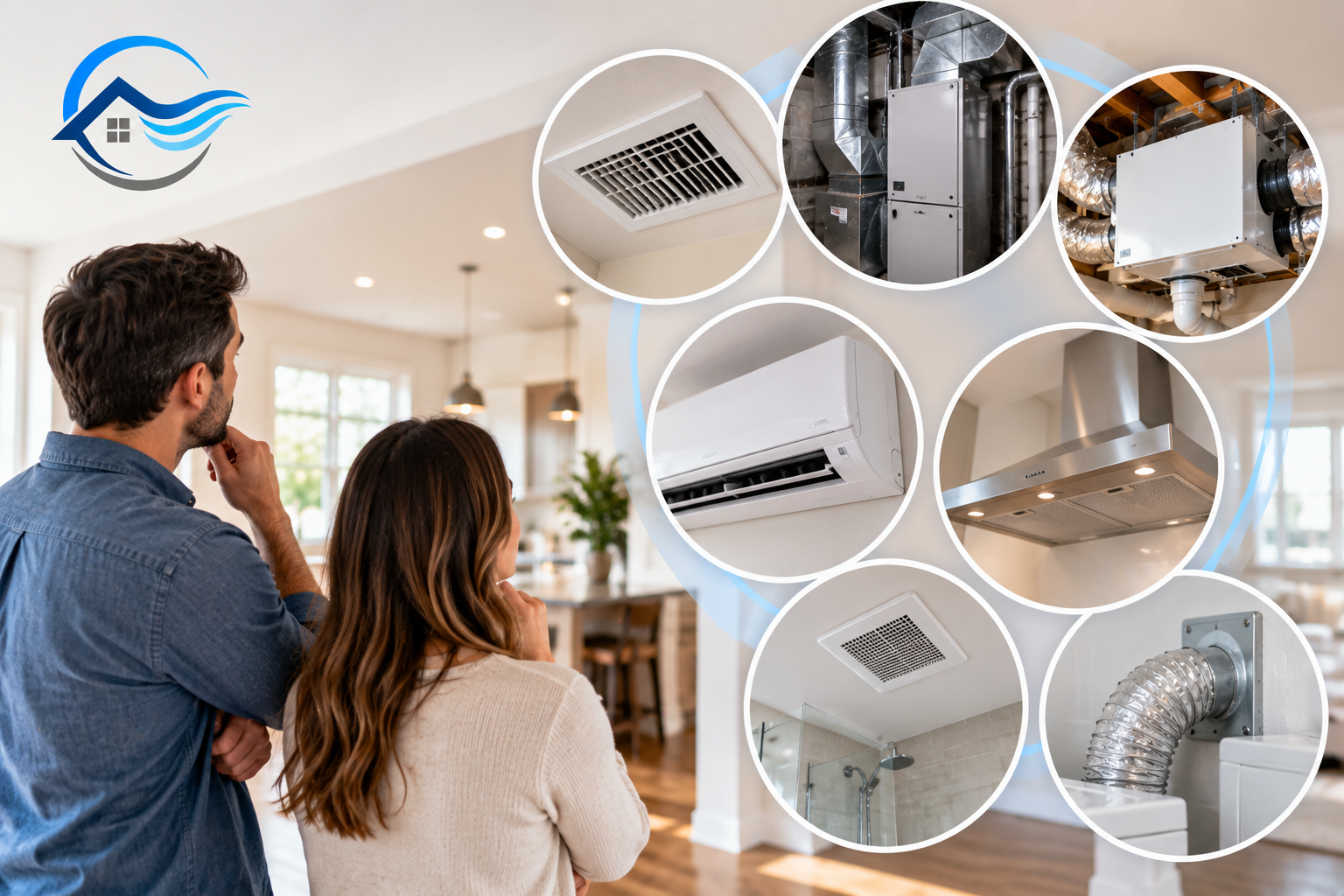
Buying a home in Montreal? Discover 7 ventilation systems worth inspecting before moving in, from air ducts and air exchangers to dryer vents and mini-splits.
Need a professional cleaning?
Our experts are available 7 days a week in Montreal, Laval and the South Shore.
Introduction
Buying a home is one of the biggest decisions most people make, and there is a long list of things to inspect before moving in.
The roof gets checked.
The foundation gets attention.
Plumbing, electricity, windows, heating equipment, and insulation are usually high on the list.
But there is another part of the property that can easily be overlooked:
the ventilation system.
A home may contain several separate ventilation and exhaust systems, each performing a different job. Depending on the property, these may include central HVAC ducts, an air exchanger, a dryer vent, a wall-mounted heat pump, bathroom exhaust fans, and a kitchen hood.
Some of these components are visible.
Much of the system is not.
You usually cannot tell what is inside a ventilation duct simply by looking at the grille from across the room.
This becomes particularly relevant when purchasing an older home, a property that has undergone renovations, or a house where you do not know the previous owner's maintenance history.
The objective is not to assume that every ventilation system in a newly purchased home needs professional cleaning.
Instead, the goal is to understand what equipment the property has, inspect its condition, identify warning signs, and determine what actually requires maintenance.
For homeowners and buyers throughout Montreal, Laval, Longueuil, Brossard, Terrebonne, Blainville, Repentigny, Vaudreuil-Dorion, the South Shore, and the North Shore, Pur Air Solutions provides professional ventilation cleaning and inspection services.
Here are 7 ventilation systems and components worth checking before or shortly after moving into a new home.
Why Inspect Ventilation When Buying a Home?
A home inspection can reveal a great deal about a property, but the internal cleanliness of every ventilation component may not always be evaluated in detail.
The previous occupants may also have had very different habits from yours.
For example, the property may previously have had:
- Pets
- Smokers
- Extensive renovations
- Heavy dryer use
- Long periods without HVAC maintenance
- Construction work
- High levels of household dust
None of these automatically means the ventilation system is contaminated or needs complete cleaning.
They simply provide useful context.
When purchasing a property, you are also inheriting its maintenance history.
If that history is unknown, inspecting important ventilation components gives you a useful baseline for future maintenance.
1. Central Furnace and Air Duct System
If the property uses a forced-air heating or cooling system, one of the first ventilation systems to identify is the central duct network.
This network typically includes supply ducts that distribute conditioned air and return ducts that bring air back toward the HVAC equipment.
Because much of the ductwork is hidden behind walls, floors, and ceilings, its condition is not always obvious.
Start by looking at accessible areas.
Check:
- Supply registers
- Return-air grilles
- Accessible duct openings
- Furnace filter
- Areas around the HVAC equipment
You may notice ordinary household dust, which is not automatically a reason for professional duct cleaning.
However, heavier accumulation, construction debris, foreign objects, or obvious contamination may justify further investigation.
Was the Home Recently Renovated?
This is an especially useful question when purchasing a property.
A newly renovated home may look extremely clean while hidden areas still contain construction dust.
Drywall sanding, flooring installation, demolition, drilling, and woodworking can all produce significant amounts of airborne dust.
If the HVAC system was not properly protected during the renovation, some of this material may have reached registers, filters, or other components.
That does not mean renovated homes automatically require duct cleaning.
But if the renovations were extensive and the condition of the system is unknown, inspection is sensible.
Pur Air Solutions offers professional furnace and air duct cleaning when the condition of the central system justifies cleaning.
2. Air Exchanger
Many homes in Quebec are equipped with an air exchanger, often an HRV or ERV.
This system plays a different role from the furnace.
Its purpose is to provide controlled ventilation by exhausting indoor air and introducing outdoor air.
Depending on the system, heat or energy is transferred between the outgoing and incoming air streams.
When purchasing a home, determine whether an air exchanger is installed and check its basic condition.
Look at:
- Filters
- Accessible internal surfaces
- Exterior intake hood
- Exterior exhaust hood
- Wall controls
- Visible duct connections
- Drainage, when applicable
Ask the seller or previous owner when the system was last maintained if that information is available.
Signs the Air Exchanger Deserves More Attention
Potential warning signs include:
- Filters heavily covered with dust
- Weak airflow
- Unusual persistent odors
- Visible internal buildup
- Exterior openings blocked by debris
- Water around the unit
- Unknown maintenance history
These signs do not necessarily mean the entire system needs replacement.
Often, the first step is simply proper inspection and maintenance.
Pur Air Solutions provides professional air exchanger cleaning for systems that require deeper cleaning.
3. Dryer Vent
The dryer vent is one of the most important exhaust systems to inspect when moving into a home.
A clothes dryer produces warm, moisture-laden exhaust that must travel through a duct and exit the building.
Although the dryer's lint filter captures a significant amount of lint, it does not capture everything.
Some lint can enter the exhaust duct.
Over time, accumulation can restrict airflow.
Lint is also combustible, which makes proper dryer exhaust maintenance an important home-safety consideration.
When buying a property, you may have no idea when the dryer vent was last inspected or cleaned.
That makes it worthwhile to locate the entire system.
What Should You Check?
Look at the dryer connection and exterior termination.
Pay attention to:
- Crushed or damaged connections
- Excessive lint around the dryer
- Visible buildup at the exterior vent
- Weak exhaust airflow
- A vent flap that does not open properly
- An unusually long or complicated duct route
If you already live in the property, additional warning signs may include clothes taking longer than expected to dry or the dryer becoming unusually hot.
These symptoms can have several causes, but the exhaust system should be part of the investigation.
Pur Air Solutions provides professional dryer vent cleaning throughout the Greater Montreal area.
4. Wall-Mounted Heat Pump or Mini-Split
Wall-mounted heat pumps have become extremely common in Montreal and throughout Quebec.
They can provide cooling during summer and, depending on the equipment and conditions, heating during colder periods.
Because they recirculate indoor air, their filters and internal components can accumulate dust over time.
When purchasing a home with an existing mini-split, inspect the indoor unit rather than judging it only by whether it turns on.
Check for:
- Dirty filters
- Visible dust around the outlet
- Unpleasant odors
- Weak airflow
- Water stains
- Signs of leakage
- Unusual sounds
A unit can still produce cold or warm air while needing maintenance.
Look Beyond the Filter
Cleaning the filters is important, but they are not the only parts of a mini-split that may accumulate debris.
Internal components can include:
- Evaporator coil
- Blower wheel
- Drain pan
- Louvers
- Condensate drainage system
If there is substantial internal buildup, professional cleaning may be appropriate.
Pur Air Solutions provides mini-split and wall-mounted heat pump cleaning for systems requiring deeper maintenance.
If the equipment has mechanical, refrigerant, or electrical problems, however, an HVAC repair professional may also be required.
Cleaning and repair are not the same service.
5. Bathroom Exhaust Fans
Bathroom ventilation is easy to overlook during a home purchase.
The fan turns on.
It makes noise.
So everything must be fine, right?
Not necessarily.
A bathroom fan can continue running even when its grille and internal components have accumulated significant dust.
The purpose of the fan is to remove humid air generated during showers and baths.
If airflow is weak, moisture may remain in the room longer.
When inspecting a home, look at each bathroom fan.
Check whether:
- The grille is heavily covered with dust
- Airflow seems weak
- The fan makes unusual noises
- Moisture remains for a long time after showers
- The duct appears to exhaust properly to the exterior
A fan that simply makes noise is not proof that it is moving enough air.
Why Bathroom Ventilation Matters
Bathrooms can generate a substantial amount of moisture in a short period.
Effective exhaust ventilation helps remove that moisture at the source.
Persistent moisture can affect mirrors, walls, ceilings, window surfaces, and other materials.
If the fan is heavily contaminated with dust or the connected exhaust duct is restricted, maintenance may improve its ability to perform as designed.
Pur Air Solutions provides professional bathroom fan cleaning for residential properties.
6. Kitchen Hood and Exhaust System
The kitchen has another important ventilation system: the range hood.
Cooking can produce:
- Moisture
- Grease particles
- Odors
- Smoke
- Other airborne cooking contaminants
A properly functioning exhaust hood can help capture and remove these contaminants at or near their source, particularly when the system exhausts outdoors.
When buying a home, inspect the hood rather than assuming it has been maintained.
Look at the filters.
Are they coated with grease?
Does the fan operate?
Does the system actually exhaust outdoors, or is it a recirculating model?
Where does the duct go?
These questions matter because not every kitchen hood is configured the same way.
Grease Accumulation Should Not Be Ignored
Kitchen grease can accumulate on filters, hood surfaces, and accessible exhaust components.
A heavily loaded filter can interfere with airflow.
Residential hood filters should be cleaned or replaced according to the manufacturer's recommendations and their actual condition.
If the system has extensive buildup beyond normal homeowner maintenance, professional service may be appropriate.
Pur Air Solutions offers kitchen hood cleaning for systems requiring deeper attention.
7. Hidden Ductwork and Camera Inspection
The biggest challenge when evaluating ventilation in a home is that much of the system cannot be seen.
A grille provides only a limited view.
Even if the first section looks clean, you may not know what is farther inside.
This can be especially relevant when:
- The home is older
- Maintenance history is unknown
- Major renovations were completed
- Objects may have fallen into ducts
- There are suspected obstructions
- Visible debris appears deeper inside
- You want to evaluate conditions before deciding on cleaning
A camera inspection can provide more information without automatically assuming that every hidden duct requires cleaning.
Pur Air Solutions provides professional HVAC camera inspection to examine areas that cannot easily be evaluated from the room.
Why Camera Inspection Can Be Useful Before Cleaning
Professional cleaning should ideally respond to an actual need.
If the condition of the ductwork is uncertain, inspection can help answer a basic question:
What is actually inside the system?
A camera may reveal:
- Dust accumulation
- Construction debris
- Foreign objects
- Certain obstructions
- Areas requiring further attention
It can also reveal that the system is in better condition than expected.
That information can help homeowners make a more informed maintenance decision.
Does Every Newly Purchased Home Need Air Duct Cleaning?
No.
Buying a home does not automatically mean the air ducts must be cleaned.
The EPA does not recommend routine duct cleaning simply as a standard procedure for every home. Instead, cleaning is generally considered when specific conditions justify it.
The same practical approach makes sense when buying a property.
Inspect first.
Understand the history.
Look for evidence of significant buildup or contamination.
Then determine whether professional cleaning is warranted.
This is more useful than treating duct cleaning as an automatic move-in requirement.
Ask About the Previous Owner's Maintenance History
If possible, ask the seller for information about ventilation and HVAC maintenance.
Useful questions include:
- When was the furnace last serviced?
- When was the HVAC filter last changed?
- Has the ductwork ever been cleaned?
- When was the air exchanger last maintained?
- Has the dryer vent been cleaned?
- Has the mini-split received professional maintenance?
- Were there recent renovations?
- Were pets present in the home?
You may not receive answers to every question.
That is fine.
Even partial information can help you determine which systems deserve closer attention.
Recently Renovated Homes Deserve Extra Attention
A freshly renovated property can be very attractive to buyers.
New flooring.
Fresh paint.
Modern kitchen.
Finished basement.
But renovation work can generate large quantities of dust.
If the HVAC system was operating during construction without adequate protection, some debris may have entered ventilation components.
Look for construction dust around:
- Floor registers
- Return grilles
- Furnace filters
- Air exchanger filters
- Mini-split units
If significant contamination is suspected, an inspection can help determine whether professional cleaning is necessary.
What About Older Montreal Homes?
Montreal contains many older properties with ventilation configurations that can differ significantly from modern construction.
Some have undergone several renovations over decades.
Systems may have been modified, extended, replaced, or partially abandoned.
When purchasing an older property, identifying what each grille and duct actually serves can be valuable.
Do not assume every visible vent belongs to the same system.
The home may contain a combination of:
- Central forced-air HVAC
- Air exchanger ducts
- Bathroom exhaust
- Kitchen exhaust
- Dryer exhaust
- Wall-mounted heat pumps
Understanding the configuration makes future maintenance much easier.
Condos Require a Different Approach
If you are buying a condo, responsibility for ventilation systems may be divided between the unit owner and the condominium association.
Some components may serve only your unit.
Others may be connected to shared building systems.
Before arranging work, determine which components you are responsible for.
This is particularly relevant for:
- Dryer vents
- Bathroom exhaust
- Central ventilation
- Shared shafts
- Exterior terminations
Building rules may also affect how and when certain systems can be serviced.
Check Exterior Ventilation Openings
Not every important ventilation component is inside the house.
Walk around the exterior and identify ventilation openings when possible.
Depending on the property, these may include:
- Dryer exhaust
- Bathroom exhaust
- Kitchen exhaust
- Air exchanger intake
- Air exchanger exhaust
Look for obvious problems such as damaged covers, debris, nests, or other obstructions.
In winter, snow and ice can also block some openings.
Keeping exterior ventilation terminations clear is an important part of maintaining airflow.
Don't Confuse Cleaning Problems With Mechanical Problems
Ventilation cleaning can address accumulated dust, lint, grease, and debris.
It cannot repair every HVAC problem.
For example, professional HVAC repair may be required for:
- Refrigerant problems
- Failed motors
- Electrical faults
- Broken controls
- Damaged heat exchangers
- Defective compressors
- Other mechanical failures
If a system does not operate correctly, determine whether the issue involves cleanliness, maintenance, installation, or mechanical repair.
Sometimes more than one service is necessary.
Before Moving In vs. After Moving In
The period before moving in can be convenient for certain maintenance tasks because the property may still be relatively empty.
Technicians may have easier access to:
- Registers
- HVAC equipment
- Mechanical rooms
- Wall-mounted units
- Dryer connections
However, you should still avoid ordering unnecessary services simply because the house is empty.
Use the opportunity to inspect first and clean the systems that actually require attention.
Create a Ventilation Maintenance Baseline
One of the biggest advantages of inspecting ventilation when purchasing a home is that it gives you a starting point.
Once you know the condition of the equipment, you can establish your own maintenance history.
Record important information such as:
- Filter type
- Filter replacement or cleaning date
- Air exchanger maintenance
- Dryer vent cleaning
- Mini-split maintenance
- Bathroom fan cleaning
- Kitchen hood maintenance
- Any camera inspection findings
Future maintenance becomes much easier when you know what was done and when.
Ventilation Inspection and Cleaning in Montreal
Buying a home comes with enough unknowns.
Your ventilation system does not need to remain one of them.
Pur Air Solutions provides several ventilation cleaning services for residential properties throughout Greater Montreal.
Depending on the property and its actual condition, services can include:
- Furnace and air duct cleaning
- Dryer vent cleaning
- Air exchanger cleaning
- Mini-split cleaning
- Bathroom fan cleaning
- Kitchen hood cleaning
- Camera duct inspection
Pur Air Solutions serves Montreal and surrounding communities including Laval, Longueuil, Brossard, Terrebonne, Blainville, Repentigny and Vaudreuil-Dorion, as well as areas of the South Shore and North Shore.
For additional information about ventilation maintenance and indoor air quality, visit the Pur Air Solutions Blog.
Conclusion
When buying a home, it is easy to focus on the visible parts of the property.
But ventilation systems can have a significant maintenance history that is largely hidden from view.
Before or shortly after moving in, identify and inspect the property's major ventilation systems:
the central HVAC ducts, air exchanger, dryer vent, wall-mounted heat pump, bathroom fans, kitchen hood, and hidden ductwork.
You do not need to assume that all seven require professional cleaning.
Instead, check their condition.
Look for visible buildup.
Ask about maintenance history.
Pay attention to airflow, odors, moisture, and unusual operation.
Use camera inspection when hidden duct conditions genuinely need to be evaluated.
Then clean or service the components that actually require attention.
This approach gives you something valuable when moving into a new property: a clear starting point for the future maintenance of your home's ventilation systems.
For homeowners and homebuyers throughout Greater Montreal, Pur Air Solutions provides professional ventilation cleaning and inspection services for multiple systems throughout the home.
FAQ — Ventilation Inspection When Buying a Home
Should I clean the air ducts before moving into a newly purchased home?
Not automatically. The need for duct cleaning should depend on the actual condition of the system, maintenance history, visible accumulation, renovation debris, or other evidence that cleaning is warranted.
What ventilation systems should I check before buying a house?
Depending on the property, check the central HVAC system, air exchanger, dryer vent, wall-mounted heat pump, bathroom fans, kitchen hood, and relevant exhaust or ventilation ducts.
Should I inspect the ventilation after renovations?
Yes, particularly after major dusty renovations. Construction dust can reach filters, registers and other HVAC components if the system was not adequately protected.
Why is the dryer vent important when buying a home?
The previous owner's cleaning history may be unknown. Lint can accumulate inside the exhaust duct and restrict airflow, so checking the dryer vent provides a useful maintenance baseline.
Is a camera inspection useful before duct cleaning?
It can be useful when the condition of hidden ductwork is uncertain. It allows some internal areas to be evaluated before deciding whether cleaning is appropriate.
Does Pur Air Solutions inspect and clean multiple ventilation systems?
Yes. Pur Air Solutions provides services including furnace and duct cleaning, dryer vent cleaning, air exchanger cleaning, mini-split cleaning, bathroom fan cleaning, kitchen hood cleaning, and camera inspection throughout Greater Montreal.