
Air Duct Cleaning After Renovations: Why Construction Dust Shouldn’t Stay in Your HVAC System
By the Pur Air Solution team · September 23, 2026
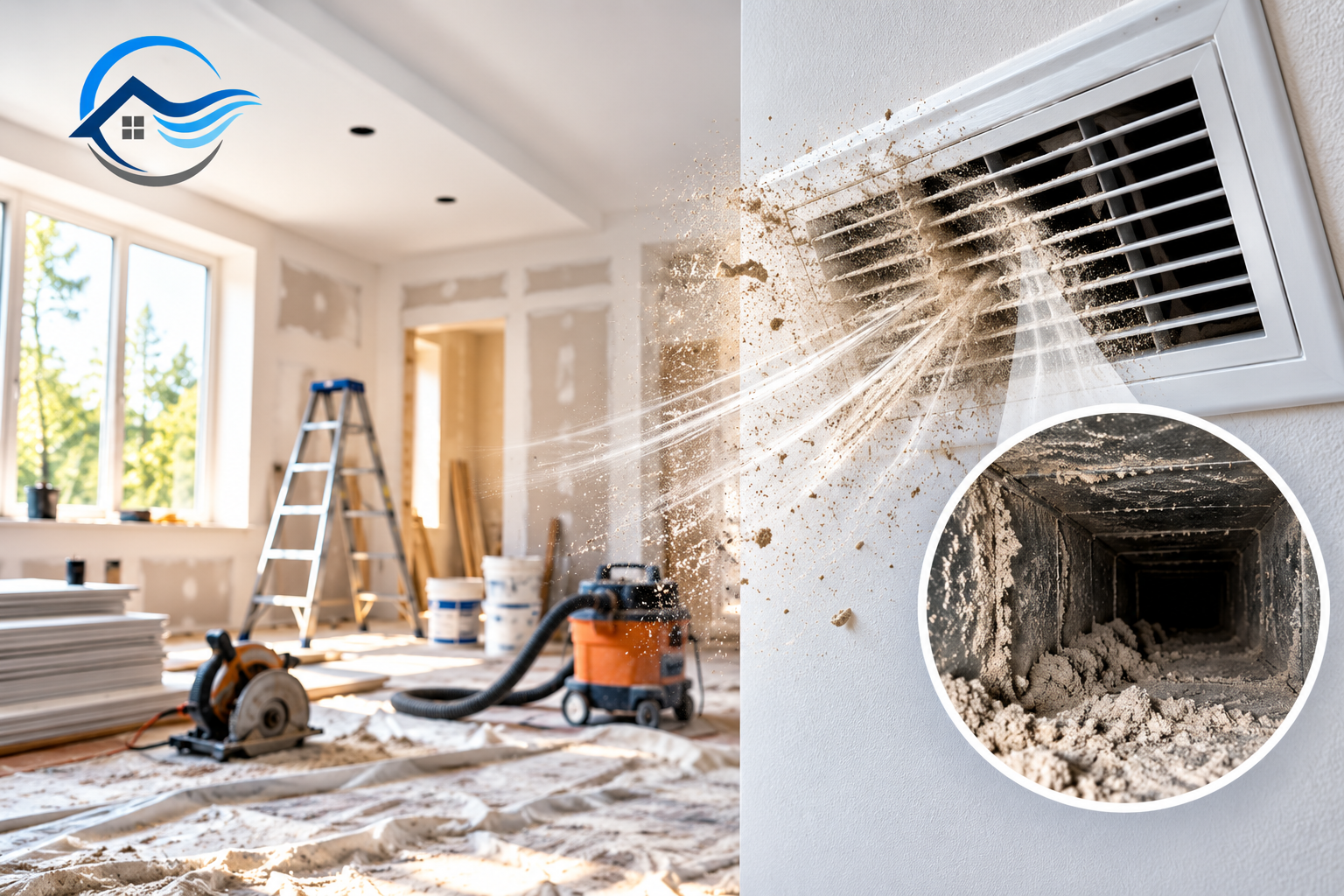
Learn when air duct cleaning after renovations may be necessary and how to keep construction dust from remaining in your HVAC system.
Need a professional cleaning?
Our experts are available 7 days a week in Montreal, Laval and the South Shore.
Introduction
A renovation can completely transform a home. New flooring, freshly painted walls, a remodeled kitchen, a finished basement, or a redesigned bathroom can make a property feel new again.
But once the contractors leave and the visible dust has been cleaned, there may still be one area homeowners forget to check: the HVAC and ventilation system.
Renovation work can generate substantial amounts of dust and fine particles. Cutting drywall, sanding wood, removing flooring, drilling, demolition, painting, and installing new materials can all introduce contaminants into the indoor environment. Health Canada specifically identifies renovation activities such as cutting and sanding as potential sources of indoor fine particulate matter and recommends controlling dust at its source. Gouvernement du Canada
Even when contractors use barriers and dust-control equipment, some particles can migrate beyond the immediate work area.
If your home's HVAC system is operating during construction, air movement may carry some of that dust toward return-air grilles, filters, registers, and other components.
That does not mean every renovation automatically requires complete air duct cleaning. The need depends on how dusty the project was, how well the work area was isolated, whether the HVAC system was protected, and the actual condition of the ducts afterward.
However, after a major or particularly dusty renovation, inspecting your HVAC system is a sensible part of post-construction cleanup.
For homeowners in Montreal, Laval, Longueuil, Brossard, Terrebonne, Blainville, Repentigny, Vaudreuil-Dorion, the South Shore, and the North Shore, Pur Air Solution provides professional residential and commercial ventilation cleaning services, including post-construction applications. Pur Air currently identifies post-construction cleaning as one of its commercial services for removing drywall dust, sawdust, and construction debris from ventilation systems. Pur Air Solution
Why Do Renovations Create So Much Dust?
Construction and renovation projects involve materials that can release particles when they are cut, drilled, sanded, removed, or installed.
Depending on the project, renovation dust can come from:
- Drywall and joint compound
- Wood and sawdust
- Flooring materials
- Insulation
- Tile and masonry work
- Sanding
- Drilling
- Demolition debris
- General construction dirt
Health Canada specifically notes that renovation activities such as cutting and sanding wood can generate fine particulate matter indoors. It recommends moving dusty work outside where possible or using local exhaust ventilation for dusty indoor work. Gouvernement du Canada
The amount of dust produced varies considerably.
Replacing a faucet is very different from demolishing and rebuilding an entire basement.
This is why post-renovation HVAC maintenance should be based on the actual project rather than automatically assuming every renovation requires the same treatment.
How Can Construction Dust Reach the HVAC System?
A central HVAC system continuously moves air between different parts of a home.
Return-air grilles draw air toward the system, while supply registers distribute conditioned air back into the rooms.
During a renovation, airborne dust can move throughout the house.
If the work area is not properly isolated or the ventilation system is operating without adequate protection, some particles may reach:
- Return-air grilles
- Supply registers
- Filters
- Furnace components
- Blower areas
- Duct surfaces
Larger debris may also accidentally enter floor registers when covers are removed or inadequately protected.
The objective during construction should therefore be to prevent contamination in the first place.
Health Canada recommends sealing off work areas to reduce the movement of dust and fumes into other areas of the home. Gouvernement du Canada
1. Drywall Work Can Generate Significant Dust
Drywall installation and finishing are common parts of renovations.
Sanding joint compound can generate a substantial amount of fine dust.
Anyone who has renovated a basement or replaced interior walls knows how easily this dust can travel.
It can settle on:
- Furniture
- Floors
- Shelves
- Window frames
- Registers
- Grilles
If significant amounts reach the ventilation system, simply cleaning the floors afterward may not address every affected area.
After a major drywall project, inspecting registers, filters, and accessible HVAC components is therefore worthwhile.
2. Woodworking and Sanding Also Produce Airborne Particles
Drywall is not the only source of renovation dust.
Woodworking activities can also generate significant quantities of airborne particles.
Projects involving hardwood floors, cabinets, framing, stairs, or custom carpentry may require extensive cutting and sanding.
Health Canada recommends moving dusty activities such as cutting and sanding outside when possible. Gouvernement du Canada
When this work must occur indoors, proper containment and dust extraction become particularly important.
3. Your Furnace Filter Deserves Attention After Renovations
One of the first HVAC components homeowners should check after dusty construction is the filter.
Its purpose is to capture particles from air passing through the system, according to the design and efficiency of the filter.
A renovation can expose the filter to much more dust than ordinary household activity.
Health Canada specifically recommends considering a furnace-filter change when renovation work has been particularly dusty. Gouvernement du Canada
Always use a filter compatible with your HVAC equipment and follow the manufacturer's recommendations.
Installing a filter that is not suitable for your system is not necessarily an improvement.
4. Visible Cleaning Is Only Part of Post-Renovation Cleanup
After contractors leave, homeowners usually focus on visible surfaces.
Floors are vacuumed.
Counters are wiped.
Furniture is cleaned.
Construction materials are removed.
Those steps are important, but dust can settle in areas that are less obvious.
Health Canada recommends thoroughly cleaning a home after renovations and suggests damp cleaning of hard surfaces and, where possible, using a HEPA-filtered vacuum to capture small particles. Gouvernement du Canada
Registers and HVAC components should therefore be included in your post-renovation inspection.
5. Not Every Renovation Requires Complete Duct Cleaning
This point is important.
A small renovation does not automatically mean that your entire ventilation system needs professional cleaning.
If the work area was properly isolated, registers were protected, the HVAC system was managed appropriately, and there is no evidence that significant construction debris entered the system, complete duct cleaning may not be necessary.
The decision should be based on actual conditions.
Possible reasons to investigate further include:
- Visible construction debris inside registers
- Heavy dust accumulation after the project
- Debris accidentally falling into floor ducts
- A very dusty renovation performed without adequate containment
- Significant construction activity near return-air grilles
- Evidence of contamination inside accessible HVAC components
When there is uncertainty, inspection can be more useful than simply assuming a cleaning is required.
6. Camera Inspection Can Help Determine What Is Actually Inside
One of the challenges with air ducts is simple: most of the system is hidden.
You can remove a register and look into the first section, but that tells you very little about areas farther inside the network.
This is where a professional camera inspection can be useful.
Pur Air Solution's camera duct inspection service is designed to help evaluate the condition of ventilation ducts.
After a renovation, an inspection may help identify visible:
- Dust accumulations
- Construction debris
- Foreign objects
- Obstructions
- Areas that may justify further cleaning
It also helps avoid treating duct cleaning as an automatic requirement.
If the ducts are reasonably clean, the homeowner has better information before deciding what to do next.
7. Renovation Dust Can Reach More Than the Ducts
The HVAC system consists of more than supply and return ducts.
Depending on the type of installation, homeowners may also need to consider:
- Furnace components
- Filters
- Air returns
- Supply registers
- Air exchangers
- Mini-splits
- Exhaust fans
For example, a wall-mounted heat pump located close to a renovation area can accumulate construction dust on filters and internal components.
Similarly, an air exchanger operating during a major project may require inspection or maintenance afterward.
Pur Air provides separate services for air exchanger cleaning and mini-split and heat pump cleaning.
8. Renovation Materials Can Affect Indoor Air in Different Ways
Dust is not the only consideration during a renovation.
Health Canada notes that building and renovation materials may also release contaminants such as volatile organic compounds (VOCs), depending on the products being used. Sources can include paints, varnishes, flooring, glues, solvents, insulation, and wood products. Gouvernement du Canada
Duct cleaning is not a solution for every type of indoor contaminant.
For gases and VOCs, controlling the source and providing adequate ventilation are particularly important.
Health Canada recommends sufficient ventilation during major projects such as painting, varnishing, cleaning, and other home improvements. Gouvernement du Canada
This distinction matters because good post-renovation indoor-air management involves more than simply cleaning ducts.
9. Ventilation Is Important During and After Renovations
Whenever outdoor conditions allow, increasing ventilation can help remove pollutants generated inside the home.
Health Canada identifies proper ventilation as a key component of good indoor air quality and specifically notes its importance during renovations and when chemical products are being used. Gouvernement du Canada
Depending on the project and outdoor conditions, strategies may include using appropriate exhaust ventilation and opening windows when conditions permit.
However, outdoor air quality also matters. Opening windows may not be appropriate during periods of significant outdoor air pollution.
The goal is controlled ventilation—not simply opening every window regardless of conditions.
10. Post-Renovation HVAC Cleaning Can Be Part of the Final Project
Homeowners often think a renovation ends when the construction crew leaves.
A more complete approach includes a final cleanup and inspection.
After significant renovations, consider checking:
- Floors and surfaces
- Registers and grilles
- Furnace filter
- Accessible HVAC components
- Air exchanger
- Mini-split or heat pump
- Exhaust fans
- The condition of the ductwork if substantial dust entered the system
This final step helps ensure that construction debris is not simply left behind in less visible areas of the property.
Signs Your HVAC System Should Be Checked After Renovations
After construction, pay attention to changes you did not notice before the work.
Examples include visible debris inside registers, unusually heavy dust around vents, noticeable debris entering the system during construction, or a filter that becomes heavily loaded with construction dust.
These observations do not automatically prove that the entire duct system needs cleaning.
They do indicate that further inspection may be worthwhile.
Renovating a Newly Purchased Home
Post-renovation HVAC inspection can be particularly relevant when purchasing an older property and renovating it before moving in.
Large projects may involve several trades working simultaneously:
- Drywall contractors
- Electricians
- Plumbers
- Flooring installers
- Painters
- Carpenters
With multiple activities producing dust, protecting the ventilation system during construction becomes increasingly important.
Once work is complete, homeowners can include HVAC inspection as part of the final preparation before occupancy.
Major Basement Renovations
Basement renovations deserve particular attention because many central HVAC components and duct runs are located in or near basements.
Finishing an unfinished basement may involve framing, drywall installation, sanding, flooring, ceiling work, drilling, and other dusty activities.
If the furnace or major return ducts are located nearby, proper protection during construction becomes particularly important.
Afterward, checking the filter and accessible HVAC components is a sensible part of cleanup.
Kitchen and Bathroom Renovations
Kitchen and bathroom renovations can also generate substantial debris.
Cabinet removal, tile cutting, drywall work, flooring replacement, and demolition can all release particles.
In addition to the central HVAC system, these rooms have their own exhaust systems.
A bathroom exhaust fan located in an active renovation area may accumulate dust.
Pur Air provides bathroom fan cleaning for systems that require maintenance.
Kitchen renovation projects may similarly affect ventilation components around the cooking area.
Should You Clean Your Ducts Before or After Renovations?
If your ducts are already scheduled for cleaning and you are about to begin a major dusty renovation, it often makes more sense to evaluate their condition after the project rather than clean them immediately beforehand—unless there is an existing issue that requires attention.
More importantly, the HVAC system should be properly protected during construction.
Preventing large quantities of dust from entering the system is preferable to allowing contamination and trying to remove it later.
After construction, the system can be inspected and the appropriate level of cleaning determined.
Professional Air Duct Cleaning After Renovations
When substantial construction debris has entered the ventilation system, professional cleaning may be appropriate.
Pur Air Solution's furnace and duct cleaning service addresses the central system, including ductwork and related components described by the company.
Pur Air Solution currently advertises residential and commercial duct-cleaning services in Montreal, Laval, the South Shore and North Shore, using professional truck-mounted equipment. Pur Air Solution
For post-construction work specifically, the company's commercial section lists removal of drywall dust, sawdust, and construction debris after renovation or new construction among its services. Pur Air Solution
Air Duct Cleaning After Renovations in Montreal
Renovations are common throughout Greater Montreal, from older properties undergoing complete remodeling to newer condos receiving customized interiors.
Pur Air Solution serves multiple communities including Montreal, Laval, Longueuil, Brossard, Terrebonne, Blainville, Repentigny and surrounding areas. Its current website identifies residential and commercial services across Montreal, Laval, the South Shore and North Shore. Pur Air Solution
For homeowners who are unsure whether construction dust has entered their system, an inspection can provide a clearer starting point than automatically booking every possible HVAC service.
You can also explore additional maintenance guides on the Pur Air Solution Blog.
Conclusion
Renovations can improve the appearance, functionality, and comfort of a home, but they can also generate substantial amounts of dust and airborne particles.
The best strategy begins before construction: isolate dusty work areas, use appropriate dust-control measures, protect the HVAC system, and provide adequate ventilation.
Once the work is finished, thorough cleaning should include more than the surfaces you can immediately see.
Check your furnace filter, registers, ventilation equipment, and accessible HVAC components. If the project generated substantial dust or there is evidence that debris entered the system, a professional inspection can help determine whether duct cleaning is appropriate.
The goal is not to clean air ducts unnecessarily. It is to make sure that renovation debris has not been left behind where it could interfere with the ventilation system.
For post-renovation HVAC inspection and cleaning in the Greater Montreal area, Pur Air Solution offers professional duct cleaning and camera inspection services for residential and commercial properties.
FAQ — Air Duct Cleaning After Renovations
Should air ducts always be cleaned after a renovation?
No. The need depends on the amount of dust generated, how well the HVAC system was protected and whether debris actually entered the system. Inspection can help determine whether cleaning is necessary.
Can drywall dust enter air ducts?
Yes. Fine construction dust can travel through indoor air and may reach registers or HVAC components if the work area and ventilation system are not adequately protected.
Should I replace my furnace filter after renovations?
If the renovation was particularly dusty, Health Canada recommends considering changing the furnace filter. Always follow the HVAC manufacturer's instructions. Gouvernement du Canada
How can I tell if construction debris is inside my ducts?
Visible debris around registers is one clue, but much of the duct network is hidden. A professional camera inspection can help evaluate sections that cannot easily be seen from the room.
Should duct cleaning happen before or after renovations?
For a major dusty project, protecting the HVAC system during construction and assessing it afterward is generally more logical than cleaning immediately before the work and then exposing it to construction dust.
Does Pur Air Solution offer post-renovation duct cleaning?
Yes. Pur Air Solution's current commercial services specifically include post-construction removal of drywall dust, sawdust, and construction debris.