
Why Does My Air Conditioner Smell? 7 Signs Your Wall-Mounted AC Needs Cleaning
By the Pur Air Solution team · September 30, 2026
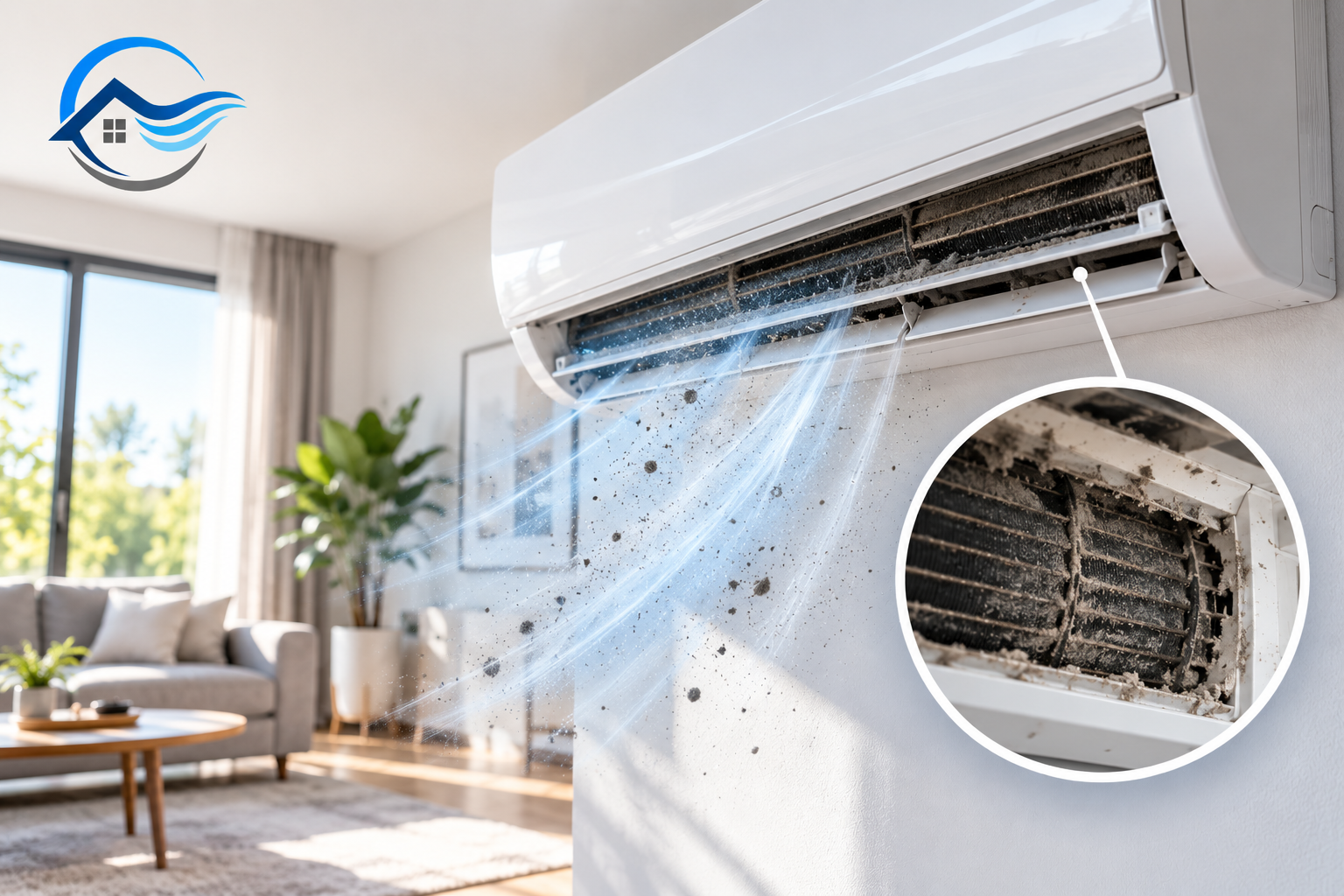
Discover 7 signs your wall-mounted air conditioner needs cleaning and what may be causing musty or unpleasant odors from your AC.
Need a professional cleaning?
Our experts are available 7 days a week in Montreal, Laval and the South Shore.
Introduction
A wall-mounted air conditioner or mini-split should make your home feel cooler and more comfortable. It should not fill the room with an unpleasant smell every time you turn it on.
Yet strange odors coming from wall-mounted air conditioners are a common concern for homeowners.
You may notice a musty smell when the system starts. Perhaps the air smells damp or stale. In other cases, the odor appears only after the air conditioner has been running for several minutes.
Whatever the situation, a persistent smell should not simply be covered up with an air freshener.
Wall-mounted air conditioners continuously move indoor air across filters and internal components. Over time, dust and other particles can accumulate inside the unit. Because air-conditioning systems also remove moisture from indoor air, certain internal areas can remain damp under some conditions.
When moisture and accumulated debris are present together, unpleasant odors can develop.
The cause is not always dirt, however. Drainage problems, electrical issues, nearby odor sources, or mechanical problems can sometimes produce similar symptoms. This is why identifying the source is more important than simply trying to mask the smell.
For homeowners in Montreal, Laval, Longueuil, Brossard, Terrebonne, Blainville, Repentigny, Vaudreuil-Dorion, the South Shore, and the North Shore, regular maintenance is especially relevant because wall-mounted heat pumps and mini-splits may be used for both cooling and heating during different parts of the year.
Pur Air Solutions provides professional mini-split and wall-mounted air conditioner cleaning for homeowners who want to maintain their equipment and address internal buildup.
Here are seven signs that your wall-mounted AC may need professional attention.
How Does a Wall-Mounted Air Conditioner Become Dirty?
Before looking at the warning signs, it helps to understand what happens inside the unit.
A wall-mounted air conditioner continuously draws room air into the indoor unit. The air passes through filters and across internal components before being returned to the room.
During this process, airborne particles may accumulate over time.
Depending on the household, these can include:
- Dust
- Pet hair
- Pollen
- Fibers
- Other airborne particles
The indoor coil also becomes cold during air-conditioning operation. As warm indoor air passes across this cold surface, moisture can condense.
This moisture is normally collected and removed through the unit's drainage system.
That means a wall-mounted air conditioner combines two conditions that require proper maintenance: airborne debris and moisture.
Filters are therefore only one part of the system that may require attention.
1. A Musty Smell Appears When the AC Starts
One of the most recognizable warning signs is a musty or damp odor that appears shortly after the system starts.
Sometimes the smell disappears after several minutes. In other cases, it remains as long as the unit is operating.
A musty odor can indicate that moisture and accumulated material are present somewhere inside the indoor unit.
Possible areas to investigate include:
- Filters
- Evaporator coil
- Blower wheel
- Drain pan
- Drainage system
The smell alone cannot identify exactly which component is responsible.
However, when the odor clearly comes from the unit and returns every time it operates, the system deserves closer inspection.
Simply spraying fragrance near the air conditioner does not solve the underlying issue.
2. The Air Smells Stale After the Unit Has Been Off
Another common situation occurs after the system has remained unused for some time.
When the air conditioner is restarted, the first air coming from the unit may smell stale.
A temporary odor does not automatically mean there is a serious problem. However, an odor that repeatedly returns or becomes stronger can indicate that internal cleaning or maintenance is needed.
This can be particularly noticeable when a cooling system is restarted after a long Montreal winter.
Before the cooling season begins, inspecting and cleaning accessible components can help prepare the system for regular summer operation.
3. You Can See Dust on the Filters or Air Outlet
Sometimes the problem is visible.
If you look at the indoor unit and notice substantial dust around the air intake, filters, louvers, or outlet, the system may be overdue for maintenance.
Filters are designed to capture particles from the air passing through the equipment. As they become loaded, airflow can be affected.
Natural Resources Canada recommends checking filters regularly and cleaning or replacing them according to the manufacturer's instructions as part of heat-pump maintenance.
But filters are not the only components that can accumulate dirt.
Dust may also reach deeper areas of the indoor unit over time.
This is one reason cleaning the filter alone may not always resolve persistent odors or performance problems.
4. Airflow Seems Weaker Than Before
A wall-mounted AC that once produced strong airflow may gradually seem weaker.
There are several possible explanations:
- Dirty filters
- Internal dust accumulation
- Fan problems
- Incorrect settings
- Mechanical issues
Accumulated dirt on filters and internal components can interfere with airflow.
This matters because the system depends on moving sufficient air across the indoor coil and back into the room.
If airflow has noticeably declined, begin by checking the maintenance recommended by the manufacturer.
If the filters are clean but the problem continues, a deeper inspection may be appropriate.
Professional mini-split cleaning can address internal areas that are not normally part of basic homeowner maintenance.
5. Water Is Dripping From the Indoor Unit
A wall-mounted air conditioner produces condensation during normal cooling operation, but that water should be properly collected and drained.
Water dripping into the room is therefore not something to ignore.
Possible causes include:
- Drainage restrictions
- Drain problems
- Installation issues
- Excessive internal buildup
- Other mechanical conditions
Water leakage can damage walls, floors, furniture, or other materials around the indoor unit.
Persistent moisture can also create conditions that should be addressed promptly.
If water is leaking from the indoor unit, turning the system off and having the cause evaluated is safer than simply placing a towel or container underneath it and continuing to use the equipment.
Cleaning may be part of the solution, but drainage or mechanical repairs may also be required.
6. The Blower Wheel Is Visibly Dirty
The blower wheel is responsible for moving conditioned air back into the room.
Because it sits deeper inside the indoor unit, homeowners may not think about it as often as the filters.
Over time, particles can accumulate on the blower wheel.
If buildup becomes substantial, it can affect the cleanliness of the unit and potentially influence airflow.
Cleaning this area is more involved than simply removing and washing a reusable filter.
A professional cleaning service can access internal components using procedures appropriate for the equipment.
This is particularly useful when visible buildup extends beyond the filters.
7. The Odor Returns Soon After You Clean the Filters
This is one of the clearest signs that the issue may be deeper inside the unit.
You remove the filters.
You clean them according to the manufacturer's instructions.
You reinstall them.
The air conditioner smells better temporarily—or perhaps not at all.
Then the unpleasant odor returns.
In this situation, the source may be located on another component.
Potential areas include the coil, blower wheel, drain pan, or drainage system.
Cleaning only the filters cannot remove buildup located deeper inside the equipment.
A professional inspection can help identify where the odor is actually coming from.
Why Moisture Matters Inside an Air Conditioner
Air conditioners do more than lower temperature.
During cooling, they also remove some moisture from indoor air.
When warm air reaches the cold evaporator coil, condensation forms on the coil. That water should travel into the drain pan and leave through the condensate drain.
This is normal operation.
Problems can develop when water does not drain correctly or when internal components remain excessively dirty.
Keeping the drainage system and indoor unit maintained is therefore important.
If you see persistent moisture, water leakage, or unusual staining around the unit, the source should be investigated.
Is Every Air Conditioner Smell Caused by Dirt?
No.
This distinction is important.
An odor coming from the area around an air conditioner does not automatically mean the unit simply needs cleaning.
Possible sources can include:
- Internal buildup
- Drainage issues
- Nearby household odors
- Electrical problems
- Mechanical problems
- External odor sources entering the room
Certain odors deserve immediate attention.
For example, if you notice a strong burning or electrical smell, turn the system off and arrange an appropriate professional evaluation rather than assuming that routine cleaning will solve the problem.
Professional cleaning is useful when contamination or buildup is the issue, but it does not replace HVAC repair when equipment is malfunctioning.
Can Mold Grow Inside a Wall-Mounted AC?
Moisture is naturally present inside an air conditioner during cooling, which means persistent moisture combined with suitable organic material can create conditions where microbial growth may occur.
However, homeowners should be careful about identifying every dark spot or musty odor as mold without proper assessment.
The important issue is to address excessive moisture, drainage problems, and accumulated debris.
If there is extensive suspected mold growth or a larger moisture problem in the building, additional professional assessment may be appropriate.
The goal should be to identify and correct the moisture source rather than simply cover the odor.
Why Cleaning the Filter Is Not Always Enough
Filter maintenance is one of the most important tasks homeowners can perform themselves.
Depending on the model, filters may be reusable or replaceable.
Always follow the manufacturer's instructions.
But the filter is only the first layer of the indoor unit.
Behind it are components such as:
- Evaporator coil
- Blower wheel
- Drain pan
- Louvers
- Internal surfaces
These components may accumulate dirt over time even when filters are maintained.
That is why a system can sometimes look clean from the outside while deeper areas need attention.
How Often Should a Wall-Mounted Air Conditioner Be Cleaned?
There is no single professional-cleaning schedule that applies perfectly to every mini-split or wall-mounted AC.
Maintenance requirements depend on:
- Manufacturer recommendations
- Frequency of use
- Number of occupants
- Pets
- Dust levels
- Location of the unit
- Whether the equipment also provides heating
- Condition of the filters
- Indoor environmental conditions
Filters generally require more frequent attention than deep internal cleaning.
A system operating every day during summer may require more maintenance than one used occasionally.
Instead of relying only on a calendar, pay attention to the equipment itself.
Changes in odor, airflow, drainage, or visible cleanliness can indicate that additional maintenance is appropriate.
The Difference Between DIY Maintenance and Professional Cleaning
Homeowners can perform several basic maintenance tasks.
Depending on the manufacturer's instructions, these may include:
- Checking filters
- Cleaning reusable filters
- Keeping the area around the indoor and outdoor units clear
- Watching for leaks
- Monitoring unusual sounds or smells
Deep cleaning is different.
Accessing the blower wheel, coil, drain pan, and other internal areas may require partial disassembly and appropriate cleaning equipment.
Improperly handling electrical components or delicate coil fins can damage the equipment.
Professional cleaning is therefore particularly useful when the buildup is located deeper inside the unit.
Why Wall-Mounted AC Cleaning Matters in Montreal
Montreal's climate places unusual demands on wall-mounted heat pumps and air conditioners.
During summer, they may operate frequently for cooling and dehumidification.
Many mini-split heat pumps are then used again during cooler weather for heating.
This means some systems operate during a large portion of the year.
Homes in Laval, Longueuil, Brossard, Terrebonne, Blainville, Repentigny, Vaudreuil-Dorion, the South Shore, and the North Shore experience similar seasonal conditions.
Regular inspection and maintenance can therefore help keep heavily used equipment in appropriate operating condition throughout changing seasons.
When Is the Best Time to Clean a Wall-Mounted AC?
One convenient time is before the beginning of the main cooling season.
Spring maintenance allows homeowners to inspect the system before heavy summer use.
Another appropriate time is whenever warning signs appear.
You do not need to wait until spring if:
- A persistent odor develops
- Airflow declines significantly
- Water begins leaking
- Internal buildup becomes visible
- The system behaves differently from normal
Problems should be addressed when they appear.
Can a Dirty Mini-Split Affect Performance?
Accumulated dirt can interfere with normal airflow.
A system needs to move air efficiently across its internal components.
Natural Resources Canada emphasizes proper filter maintenance and unobstructed airflow as part of heat-pump maintenance.
If airflow is restricted, system performance may suffer.
However, poor performance can also result from refrigerant problems, mechanical failures, incorrect sizing, installation problems, or other technical issues.
Cleaning should therefore be viewed as one part of HVAC maintenance—not a solution for every performance problem.
What Happens During Professional Mini-Split Cleaning?
The exact procedure depends on the equipment, its condition, and the service provider.
Generally, professional cleaning focuses on accessible internal areas where dust and buildup can accumulate.
The technician may evaluate components such as:
- Filters
- Indoor coil
- Blower wheel
- Louvers
- Drain pan
- Condensate drainage
The purpose is to remove accumulated material while protecting electrical and mechanical components.
If the technician identifies a mechanical problem rather than a cleaning issue, additional HVAC service may be necessary.
Other Ventilation Systems Can Affect Indoor Comfort
Your wall-mounted air conditioner is only one part of the home's indoor environment.
Depending on the property, you may also have:
- Central ductwork
- Air exchanger
- Bathroom exhaust fans
- Kitchen hood
- Dryer vent
Each system has a different purpose.
For example, an air exchanger helps provide controlled ventilation, while a bathroom fan removes moisture from a specific room.
Pur Air Solutions also provides air exchanger cleaning, bathroom fan cleaning, and other ventilation cleaning services.
Looking at the home as a complete ventilation system can help identify problems more accurately.
Wall-Mounted Air Conditioner Cleaning in Montreal
Pur Air Solutions provides professional HVAC and ventilation cleaning services throughout the Greater Montreal area.
For wall-mounted systems, its mini-split cleaning service is designed to clean components that may accumulate dust and debris during regular operation.
Service areas include Montreal and surrounding communities such as Laval, Longueuil, Brossard, Terrebonne, Blainville, Repentigny and Vaudreuil-Dorion, as well as areas of the South Shore and North Shore.
For more information about HVAC maintenance, ventilation systems, and indoor air quality, visit the Pur Air Solutions Blog.
Conclusion
An unpleasant smell coming from a wall-mounted air conditioner should not simply become something you learn to live with.
A musty or stale odor can be a sign that filters or internal components require attention, particularly when it appears every time the system operates.
Visible dust, weaker airflow, water leakage, dirty internal components, and odors that return immediately after filter cleaning are additional signs that a deeper inspection may be appropriate.
At the same time, not every smell is a cleaning problem. Electrical, mechanical, drainage, or other issues may require a different type of professional service.
The best approach is to identify the cause rather than mask the symptom.
Regular filter maintenance combined with periodic inspection and professional cleaning when necessary can help keep a wall-mounted air conditioner operating under cleaner conditions.
For homeowners throughout Greater Montreal, Pur Air Solutions offers professional mini-split and wall-mounted AC cleaning.
FAQ — Wall-Mounted Air Conditioner Cleaning
Why does my wall-mounted air conditioner smell musty?
A musty smell can be associated with moisture and accumulated material inside the indoor unit. Filters, the coil, blower wheel, drain pan, and drainage system are among the areas that may need inspection.
Will cleaning the filters remove the smell?
Sometimes, particularly if dirty filters are the source. If the odor quickly returns, however, buildup may be present deeper inside the unit.
Why is water dripping from my wall-mounted AC?
Air conditioners naturally produce condensation, but it should drain properly. Indoor leakage may indicate a drainage restriction, installation problem, or another issue that should be evaluated.
How often should I clean my mini-split filters?
Follow the manufacturer's recommendations because maintenance intervals vary by model and usage. Systems operating frequently generally require more regular filter checks.
Does a bad smell always mean the AC is dirty?
No. Some odors can have electrical, mechanical, drainage, or external causes. A burning or electrical odor should be treated as a potential equipment problem rather than simply a cleaning issue.
Does Pur Air Solutions clean wall-mounted air conditioners in Montreal?
Yes. Pur Air Solutions provides professional mini-split and wall-mounted system cleaning in Montreal and several surrounding communities.